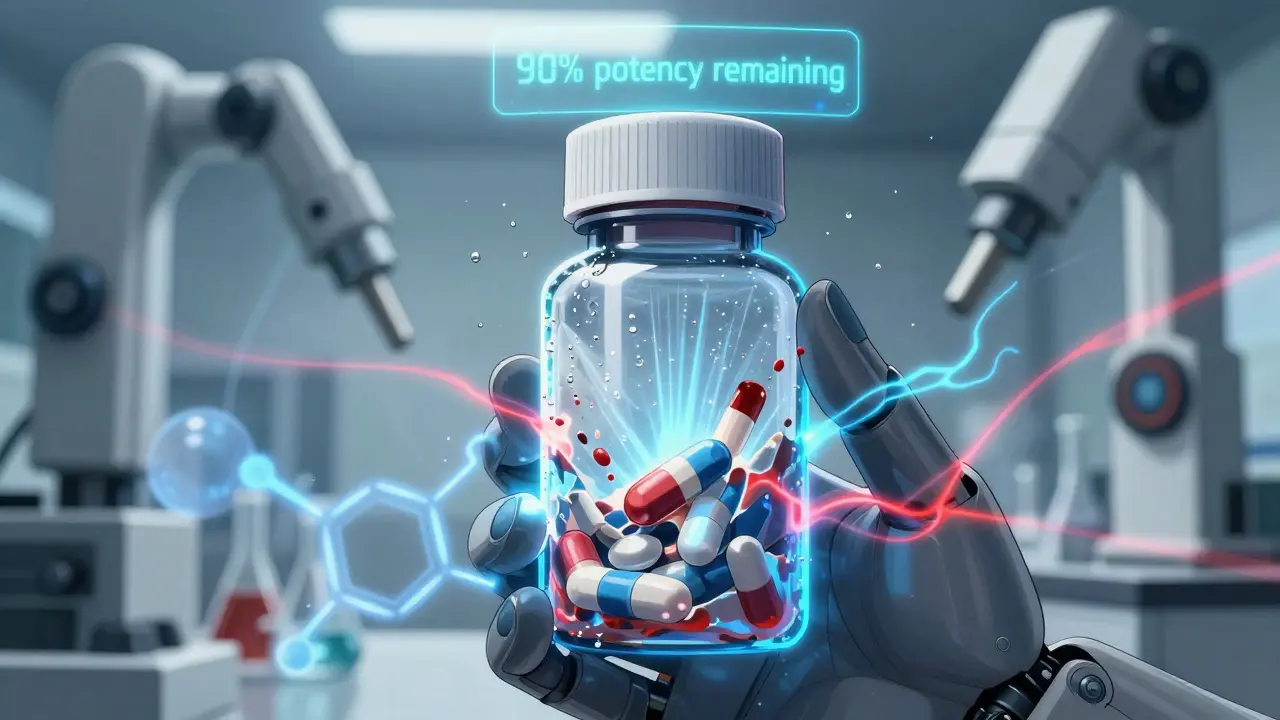
Most people think expired medications suddenly become useless on the date printed on the bottle. That’s not true. The truth is, medications start losing potency the moment they’re made-not when the clock hits midnight on their expiration date. This isn’t a marketing trick or a way for drug companies to push sales. It’s chemistry. And understanding how and why it happens could save your life-or someone else’s.
What the Expiration Date Actually Means
The expiration date on your pill bottle isn’t a "use-by" date like milk. It’s a guarantee. The manufacturer promises that, under proper storage, the drug will still contain at least 90% of the active ingredient listed on the label. So if your ibuprofen tablet says it contains 200 mg, by the expiration date, it should still have at least 180 mg. That’s not a safety cutoff. It’s a potency floor. This standard comes from the United States Pharmacopeia (USP), which sets the rules for how drugs are tested and labeled. The FDA made expiration dating mandatory in 1979. Before that, many drugs had no clear shelf life, leading to inconsistent quality and safety. Now, every prescription and over-the-counter medicine has to prove, through testing, that it will stay strong enough to work until the date printed on the package.How Medications Break Down
Drugs don’t just "wear out." They chemically break apart. The active ingredients-called APIs (active pharmaceutical ingredients)-react with air, moisture, heat, and light. These reactions turn the original compound into something else. Sometimes it’s harmless. Sometimes it’s dangerous. There are four main ways this happens:- Hydrolysis: Water breaks chemical bonds. This is why moisture is the enemy of pills. Even humidity in the air can trigger it.
- Oxidation: Oxygen in the air reacts with the drug. Think of it like rust, but for medicine.
- Photolysis: Light, especially UV, breaks down molecules. That’s why some drugs come in dark bottles.
- Thermal degradation: Heat speeds up all chemical reactions. A pill stored in a hot car can degrade faster than one sitting in a cool drawer.
Some Drugs Last Way Longer Than Others
Not all medications are created equal when it comes to shelf life. Solid forms-tablets and capsules-tend to be the most stable. That’s because they’re dry and tightly packed. Liquid medicines, especially suspensions like amoxicillin for kids, break down much faster. Once you mix them, they often need refrigeration and must be used within days. A 2020 study by the National Institutes of Health looked at drugs stored on the International Space Station. Even after being exposed to radiation and temperature swings for years, many solid drugs still met potency standards. Ibuprofen, for example, held up remarkably well. But others didn’t. Levothyroxine (for thyroid issues), epinephrine (in EpiPens), and certain antibiotics like amoxicillin/clavulanate lost potency faster than expected-even before their expiration dates. Why? Because of their chemical structure. Some molecules are just more fragile. And it’s not just the active ingredient. The filler materials-called excipients-can make a big difference. A 2017 study found that different brands of ibuprofen degraded at different rates because of the specific gums, binders, and coatings used. Two pills with the same active ingredient could have different shelf lives just because of what else was in them.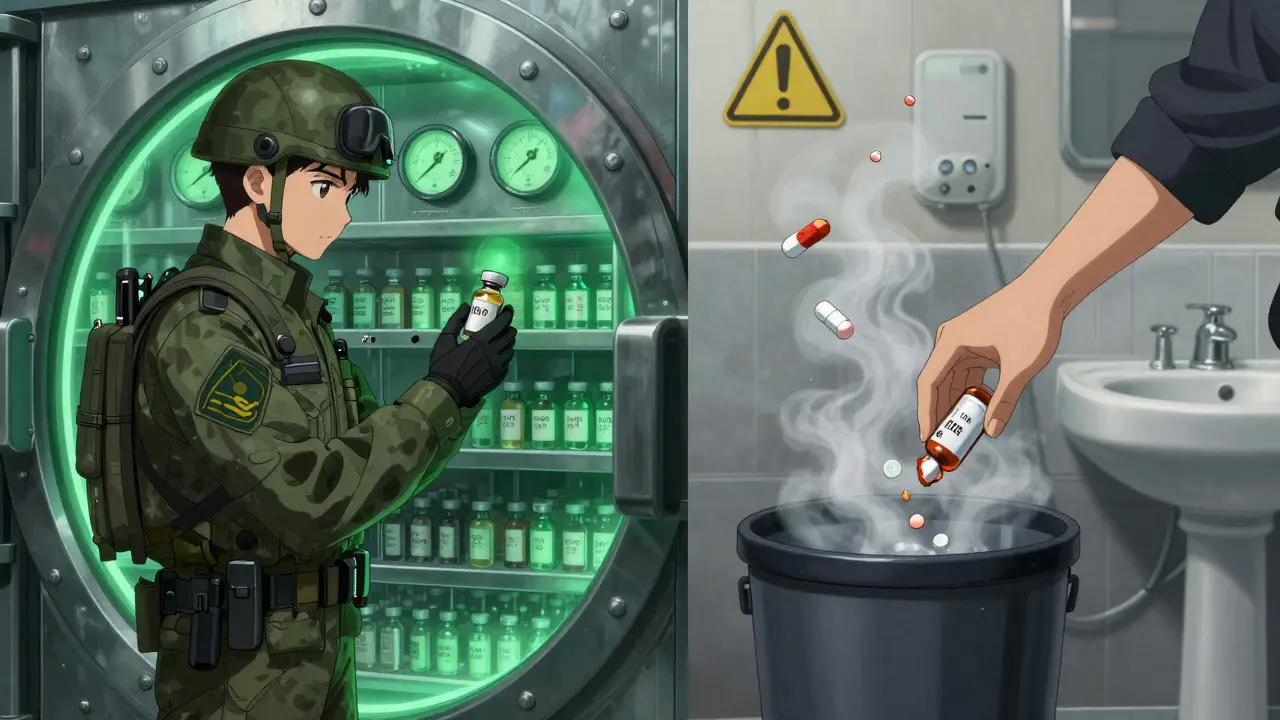
Storage Matters More Than You Think
Where you keep your medicine is just as important as when you bought it. The bathroom is the worst place. Every time you take a shower, you turn the room into a steamy, humid sauna. That moisture seeps into pill bottles and accelerates hydrolysis. Studies show bathroom storage can cut a drug’s shelf life by 30-50% compared to a bedroom or closet. Heat is another silent killer. Storing insulin in a hot car or keeping antibiotics on a windowsill can destroy them in weeks. The FDA and manufacturers test drugs under extreme conditions-40°C (104°F) and 75% humidity-to simulate two years of aging in just six months. If a pill survives that, it’s likely to last its labeled expiration date. But if you leave it in a garage in Arizona, you’re basically doing your own accelerated aging test. Light exposure also matters. Tetracycline antibiotics turn toxic when exposed to sunlight. That’s why they come in amber bottles. Even clear bottles can let in enough light to degrade sensitive drugs over time.Why the FDA Says: Don’t Use Expired Medications
You might read stories about soldiers using 10-year-old antibiotics that still worked. Or about people who took expired epinephrine and survived an allergic reaction. Those cases exist. But they’re exceptions. The FDA’s official stance is clear: once the expiration date passes, there’s no guarantee the drug will be safe or effective. Why? Because you can’t know how it was stored. A pill that sat in a cool basement for five years might still be good. One that was left in a hot car for a month? Not so much. The biggest danger isn’t just weak pills. It’s sub-potent antibiotics. If an antibiotic doesn’t have enough active ingredient, it won’t kill all the bacteria. The survivors multiply-and become resistant. That’s how superbugs form. Emergency drugs like EpiPens are another critical case. Even a 10% drop in epinephrine can mean the difference between life and death during anaphylaxis. A 2017 study showed that EpiPens past their expiration date delivered significantly less epinephrine. That’s not a risk worth taking.
The Military’s Secret: Drugs That Last 15 Years
Here’s something most people don’t know: the U.S. military runs a program called the Shelf Life Extension Program (SLEP). Since 1986, they’ve tested thousands of stockpiled drugs-many years past their labeled expiration dates. They found that 88% of them still met potency standards. Some were effective up to 15 years after manufacture. This isn’t magic. It’s science. The military stores drugs in climate-controlled warehouses with low humidity, stable temperatures, and no light exposure. Their storage conditions are perfect. Consumer homes? Not even close. The SLEP saved the Department of Defense over $2 billion between 2006 and 2016. But that program doesn’t apply to you. You don’t have a military-grade storage facility. And you can’t test your pills in a lab to see if they’re still good.What You Should Do
Here’s a simple rule: Don’t take expired medications if they’re for something critical. That includes:- Heart medications (like nitroglycerin)
- Insulin and other diabetes drugs
- Seizure medications
- Epinephrine auto-injectors
- Antibiotics
8 Comments
Akshaya Gandra _ Student - EastCaryMS
i just took some old ibuprofen last week bc my head was killin me and it worked?? like, is that just luck or are some pills just chill af??
also why do we even have expiration dates if they last 15 years in military storage?? feels like a scam.
en Max
It is imperative to underscore that the pharmacokinetic integrity of pharmaceutical agents is contingent upon environmental variables, including relative humidity, thermal exposure, and photolytic degradation. The United States Pharmacopeia (USP) stipulates a minimum potency threshold of 90% at expiration, yet real-world storage conditions-particularly in domestic environments-frequently deviate from the controlled parameters under which these tests are conducted. Consequently, the assumption of therapeutic equivalence post-expiration is, in a strict clinical context, unwarranted.
Angie Rehe
Ugh, people are so lazy. You don’t store insulin in a hot bathroom and then act shocked when it doesn’t work. This isn’t rocket science. If you’re too cheap or too lazy to replace your EpiPen, don’t blame the FDA when your kid dies. And stop pretending expired antibiotics are ‘fine’-you’re not a soldier in a desert, you’re a person who left their meds in the glovebox of their Honda Civic.
Jacob Milano
Man, I love this breakdown. It’s like watching a science doc but for your medicine cabinet.
Did you know some pills are basically little chemical time bombs? Like, levothyroxine? Super fragile. One hot summer day in your car and it’s basically candy. Meanwhile, ibuprofen? That little guy’s got the endurance of a marathon runner who’s never missed a workout.
And the military thing? That’s wild. They’ve got these vaults colder than my ex’s heart, and the drugs just chill for 15 years. Meanwhile, my Advil’s been in the same drawer since 2020 and I still take it. Probably should’ve tossed it. But hey, I’m still here, right?
Enrique González
Good info. I’ve always kept mine in the bedroom drawer. No bathroom, no sun, no heat. Simple. But I never knew how much the fillers mattered. Two ibuprofen pills, same label, different shelf life? That’s wild. Makes you wonder what else they’re hiding in those little tablets.
Aaron Mercado
STOP. JUST STOP. People are dying because they think expired meds are "probably fine." You’re not a chemist. You’re not a lab. You don’t know what’s in that pill anymore. That antibiotic you took from 2019? It didn’t kill the bacteria-it trained it. And now you’ve helped create a superbug. You’re not being clever. You’re being reckless. And if you’re lucky, you’ll just get sick. If you’re not lucky? You’ll kill someone else. Wake up.
saurabh singh
Bro, in India we’ve been taking expired meds for years-no big deal, right? But now I see why that’s risky. Still, my grandma swears by her 10-year-old aspirin. She says it works better than the new ones. Maybe it’s the placebo? Or maybe the old ones had better binders? Anyway, point is: storage matters. Don’t keep meds near the stove. And yeah, bathroom = bad. I learned that the hard way after my allergy pills turned into mush. Lesson learned.
John Wilmerding
Thank you for this comprehensive and well-researched overview. As a pharmacist, I can confirm that the degradation pathways described-hydrolysis, oxidation, photolysis, and thermal degradation-are empirically validated and well-documented in pharmaceutical stability studies. While the Shelf Life Extension Program demonstrates remarkable stability under ideal conditions, consumer environments rarely replicate those parameters. For critical medications such as insulin, nitroglycerin, and epinephrine, expiration dates are not suggestions-they are life-or-death thresholds. I strongly encourage all patients to consult their pharmacist before using any medication beyond its labeled expiration date, particularly if storage conditions are unknown. Proper disposal of expired pharmaceuticals is also essential to prevent environmental contamination and accidental ingestion.