
Most people think sunscreen is just for beach days or summer vacations. But if you’re not using it every day, you’re leaving your skin vulnerable to damage - even on cloudy days, through windows, or while driving to work. The truth? UV radiation doesn’t take a day off. And neither should your protection.
What SPF Actually Means (And Why It’s Not What You Think)
SPF stands for Sun Protection Factor. It measures how well a sunscreen blocks UVB rays - the ones that burn your skin. An SPF 30 product doesn’t mean you can stay in the sun 30 times longer without burning. It means it takes 30 times longer for your skin to redden when applied correctly.
Here’s the math: SPF 15 blocks about 93% of UVB rays. SPF 30 blocks 97%. SPF 50 blocks 98%. That’s it. There’s no magic jump from SPF 30 to SPF 100. The difference between SPF 30 and SPF 50 is just 1% more protection. But here’s the catch: most people apply only a quarter of the amount they should. When you under-apply, SPF 30 acts like SPF 7 or 8. That’s why dermatologists recommend SPF 30 or higher - it gives you a buffer for sloppy application.
UVA vs UVB: The Silent vs The Burner
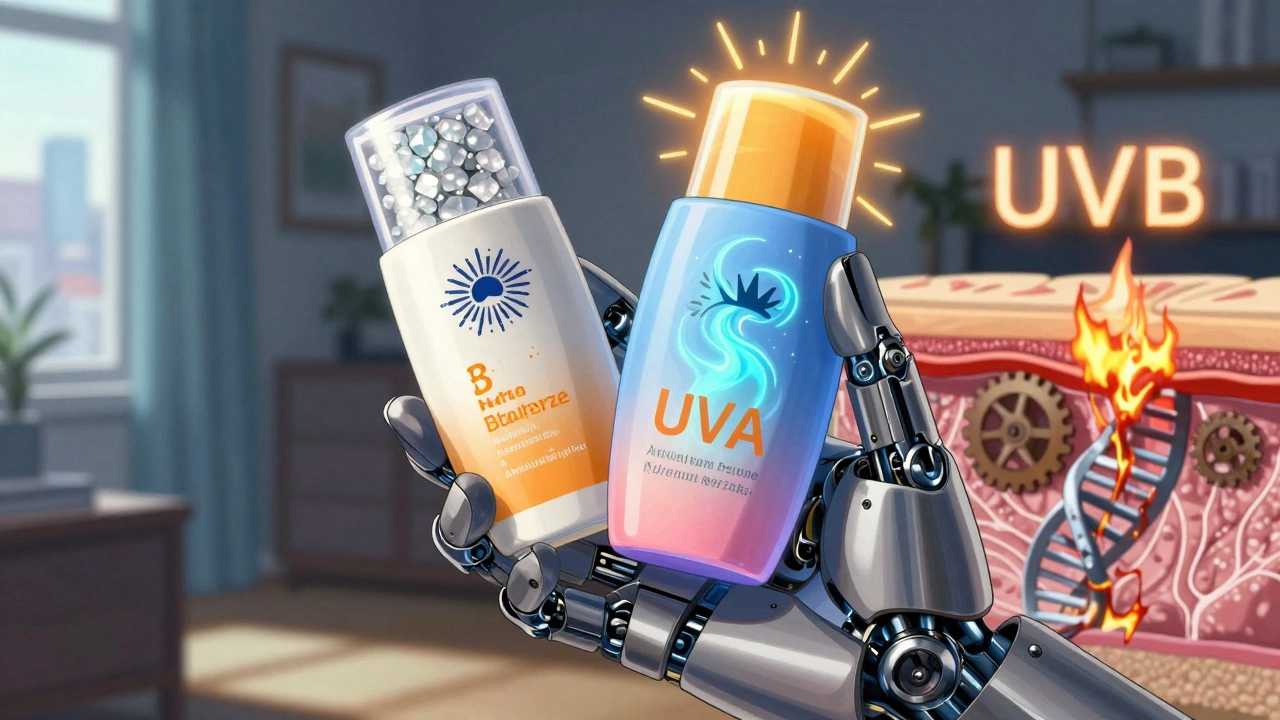
Not all UV rays are the same. UVB rays are the short-wavelength offenders. They hit the top layer of your skin (the epidermis), cause sunburns, and directly damage DNA. That’s why they’re linked to melanoma and other skin cancers.
UVA rays are the quiet destroyers. They’re longer wavelengths that penetrate deep into the dermis - where collagen and elastin live. These rays don’t burn you, but they break down your skin’s structure over time. That’s how you get wrinkles, sagging, and dark spots. UVA rays are present all day, every day, even through glass. They’re the reason you can get sun damage while sitting by a window at your desk or driving in your car.
Together, UVA and UVB make up nearly all the ultraviolet radiation that reaches Earth. UVA accounts for up to 95% of it. That’s why “broad spectrum” isn’t just marketing - it’s non-negotiable. A sunscreen labeled SPF 50 but not broad spectrum is only protecting you from half the problem.
What “Broad Spectrum” Really Means
The FDA requires sunscreens to pass a test called critical wavelength to earn the “broad spectrum” label. The product must absorb UV rays up to at least 370 nanometers. That’s the minimum. But the Skin Cancer Foundation raised the bar in 2023. Now, for their Seal of Recommendation, products with SPF 50+ must also show UVA protection that’s at least one-third of the SPF number - and they now require UVA-PFdx scores of 20 or higher for SPF 50+ sunscreens.
What does that mean for you? It means a product labeled SPF 50 should protect you from UVA rays at least as well as SPF 16 protects against UVB. If it doesn’t, it’s not truly broad spectrum. Look for the label. Don’t assume.
Mineral vs Chemical Sunscreens: Which One Should You Use?
There are two main types of sunscreen: mineral and chemical. They work in opposite ways.
Mineral sunscreens (also called physical sunscreens) use zinc oxide and/or titanium dioxide. These ingredients sit on top of your skin and physically block UV rays like a shield. They start working immediately. They’re less likely to irritate sensitive skin or trigger breakouts. That’s why many people with acne or rosacea swear by them.
But they have a downside: the white cast. Especially on darker skin tones, mineral sunscreens can leave a grayish or ashy look. Newer formulas use micronized particles and tinted bases to fix this, but you still need to rub them in well.
Chemical sunscreens use ingredients like avobenzone, octinoxate, octocrylene, and oxybenzone. These absorb UV rays like a sponge, converting them into harmless heat. They tend to be lighter, more cosmetically elegant, and blend in better. But they need 15-20 minutes to activate after application. And some ingredients - especially oxybenzone - can cause stinging, redness, or breakouts in sensitive skin.
Reddit users on r/SkincareAddiction reported that 78% of those who switched from chemical to mineral sunscreens saw fewer breakouts. But 63% complained about the white cast. On Amazon, top-rated sunscreens like La Roche-Posay Anthelios SPF 50 get 4.4 stars - mostly because users praise the “no white cast” formula. So the answer isn’t “mineral is better.” It’s “find the one that works for your skin and that you’ll actually wear every day.”
Water Resistance Isn’t Forever
If you’re swimming or sweating, you need water resistance. But “water resistant” doesn’t mean waterproof. The FDA defines it as either 40 or 80 minutes of protection while swimming or sweating. After that, you need to reapply - even if the bottle says “all-day protection.”
And don’t forget: towel-drying removes sunscreen. So reapply after drying off. Same goes for wiping your face. Sunscreen isn’t permanent makeup.
How Much Should You Actually Use?
Most people apply only 25-50% of the recommended amount. That cuts your protection in half - or worse.
For your face and neck, you need about 1/4 teaspoon. That’s roughly the size of a nickel. For your whole body, you need about one ounce - the size of a shot glass. If you’re using a spray, spray until your skin glistens, then rub it in. Spraying lightly doesn’t work.
And here’s the kicker: sunscreen wears off. Even if you’re not sweating or swimming, UV exposure breaks it down. Reapply every two hours. If you’re outside all day - walking the dog, gardening, commuting - keep a small tube or stick in your bag. No excuses.
What About Indoor Protection?
UVA rays penetrate glass. That means you’re getting exposure while sitting near a window - at home, in your car, or at your office. Studies show that people who drive daily have more sun damage on the side of their face exposed to the window. That’s not a myth. That’s science.
Dr. Leslie Baumann, a board-certified dermatologist, says: “UVA rays are equally intense during all daylight hours throughout the year.” So yes - you need sunscreen even in December. Even in Leeds. Even if it’s raining. UV rays don’t care about the weather.

The Real Cost of Skipping Sunscreen
Every time you skip sunscreen, you’re adding to your lifetime UV exposure. That exposure adds up. It doesn’t just cause wrinkles. It causes DNA damage that can lead to skin cancer. The American Academy of Dermatology says one in five Americans will develop skin cancer by age 70. Most of those cases are preventable.
And it’s not just cancer. Photoaging - the premature aging caused by the sun - accounts for up to 90% of visible skin aging. That includes dark spots, fine lines, and loss of firmness. Sunscreen is the single most effective anti-aging product you’ll ever use.
What’s Changing in 2025?
The FDA just updated sunscreen rules in June 2024. By December 2025, all sunscreens sold in the U.S. must clearly display “broad spectrum” on the front label. Products that don’t meet the standard will be pulled from shelves.
Also, the Skin Cancer Foundation now requires SPF 50+ for their Active Seal (used for sports and outdoor activities). SPF 30+ is now the minimum for daily use - up from SPF 15. That’s because research shows even low-level daily exposure adds up over time.
And the future? Dermatologists are already looking beyond UV. Blue light from screens and infrared radiation may also contribute to skin damage. Some new sunscreens now include antioxidants like vitamin C and ferulic acid to help fight free radicals from all sources. It’s not standard yet - but it’s coming.
What to Look for When You Buy
Here’s your quick checklist:
- SPF 30 or higher
- Broad spectrum (on the front label)
- Water resistant if you sweat or swim
- Mineral if you have sensitive or acne-prone skin
- Tinted if you have darker skin and hate white cast
- Free of oxybenzone and octinoxate if you care about coral reefs
Top brands like CeraVe, La Roche-Posay, and Neutrogena consistently rank high in dermatologist recommendations and consumer reviews. But don’t just buy the most expensive one. Buy the one you’ll use every single day.
Final Thought: Sunscreen Isn’t Optional
You don’t need to wear it on a beach. You don’t need to reapply every hour if you’re indoors. But you do need to apply it every morning. Like brushing your teeth. Like putting on deodorant. It’s part of basic skin care - not a luxury.
UV damage is cumulative. It doesn’t show up overnight. But it shows up. And by then, it’s too late to reverse. The best sunscreen is the one you use. Consistently. Every day. No exceptions.
Do I need sunscreen on cloudy days?
Yes. Up to 80% of UV rays penetrate cloud cover. UVA rays, which cause aging and skin damage, are especially strong even when it’s overcast. Skipping sunscreen because it’s cloudy is one of the biggest mistakes people make.
Is higher SPF always better?
Not significantly. SPF 30 blocks 97% of UVB rays. SPF 50 blocks 98%. The difference is tiny. But higher SPF gives you a safety net if you apply too little - which most people do. So SPF 30-50 is ideal. Anything above SPF 60 offers minimal extra benefit and may give a false sense of security.
Can I rely on makeup with SPF instead of sunscreen?
No. Most makeup with SPF contains too little product to offer real protection. You’d need to apply 7-10 times the normal amount of foundation to reach the labeled SPF. Use a dedicated sunscreen underneath. Makeup with SPF is a bonus - not a replacement.
Do I need sunscreen if I have dark skin?
Yes. While darker skin has more natural melanin protection, it’s not immune to UV damage. Skin cancer is often diagnosed later in people with darker skin tones - leading to worse outcomes. Plus, UVA rays still cause hyperpigmentation, dark spots, and premature aging. Broad-spectrum sunscreen is essential for everyone.
Why does my sunscreen pill under makeup?
Pilling happens when sunscreen doesn’t fully absorb before you apply other products. Let your sunscreen sit for 15 minutes before makeup. Use a lightweight formula. Avoid layering too many silicones or heavy creams on top. Some sunscreens are specifically designed to work under makeup - look for “non-pilling” on the label.
Are mineral sunscreens better for the environment?
Yes, in terms of coral reefs. Chemical filters like oxybenzone and octinoxate have been shown to harm coral ecosystems. Mineral sunscreens with non-nano zinc oxide or titanium dioxide are considered reef-safe. If you’re swimming in oceans or lakes, choose reef-safe formulas to protect marine life.
9 Comments
nithin Kuntumadugu
bro sunscreen is just a scam by big pharma to sell you overpriced lotion 😂 i've been skipping it for 10 years and my skin looks better than my 25-year-old cousin's. also, clouds block all uv anyway. why pay for nothing? 🤡
John Fred
YAS QUEEN 🙌 SPF 30+ broad spectrum is NON-NEGOTIABLE. I use CeraVe AM every morning like clockwork - even on rainy days in Seattle. UVA = silent assassin. And yes, your car window? Totally exposing you. 💪 No excuses. Skin cancer doesn’t care if you ‘feel fine’.
Cole Newman
lol you guys are overcomplicating this. mineral sunscreens? white cast? just slap on a hat and stay indoors. problem solved. also, oxybenzone is literally poison - the FDA banned it in 2023. you're all being manipulated by marketing. i've never used sunscreen and my skin's still glowing. #facts
Casey Mellish
Mate, I live in Brisbane and I’ve got more sun damage on my left cheek from driving than I ever got at Bondi. You’re absolutely right - UVA penetrates glass. I use La Roche-Posay Anthelios every single day. Tinted. SPF 50. Reapplied at lunch. No white cast. No regrets. This isn’t vanity - it’s survival. Australia’s been screaming this for decades.
Tyrone Marshall
It’s funny how we treat skincare like it’s optional. We brush our teeth, we wash our hands - but sunscreen? That’s the step people skip because ‘it’s not glamorous.’ But here’s the truth: your skin is your largest organ. It’s not just about wrinkles. It’s about cellular integrity. Every time you skip it, you’re betting against your future self. And the odds? They’re stacked.
Emily Haworth
wait… so you’re telling me my phone screen and laptop are aging my skin? and that makeup with SPF doesn’t count? 😱 i’ve been using my foundation as my ‘sunscreen’ for years… i think i’m doomed. also, is it true that blue light from screens causes free radicals? i’m scared to look at my phone now 😭
Himmat Singh
It is an empirical fallacy to assert that SPF 30 and SPF 50 offer statistically insignificant protection. The differential, while seemingly marginal, becomes significant over prolonged exposure. Furthermore, the assumption that UVA penetration through glass is negligible is contradicted by peer-reviewed photobiological studies conducted by the International Commission on Non-Ionizing Radiation Protection.
Alvin Montanez
I can't believe people still think they're safe just because they don't get sunburned. You think you're fine because you don't turn red? That's like saying you're not getting fat because you don't feel bloated. UVA is the silent killer - it doesn't burn you, it just slowly destroys your collagen, your DNA, your future. And then one day, you look in the mirror and you see a 60-year-old face at 35. And you wonder why. It's not your genes. It's not your diet. It's the 10 years you spent driving to work with the window down, thinking you were being smart. You're not smart. You're just lucky. And luck runs out.
Lara Tobin
I used to skip sunscreen because I hated how it felt… until I got a weird dark spot on my cheek that wouldn’t go away. Turns out it was solar lentigo. Took 6 months and a dermatologist to fix it. Now I use the tinted CeraVe every morning. It’s not perfect, but it’s better than crying in front of the mirror. You’re not being dramatic if you protect yourself. You’re being wise. 💙