SSLR Diagnostic Checker
Diagnostic Assessment
Please fill out the form and click "Check" to get your results
When a child develops a rash, fever, and joint pain a week after taking an antibiotic, parents often panic. Was it an allergy? Is this dangerous for life? Could they never take penicillin again? The answer might surprise you: it’s probably not a true allergy at all. It’s something called serum sickness-like reaction (SSLR), a delayed immune response that looks scary but is far less serious than it seems-and it’s being misunderstood far too often.
What Exactly Is a Serum Sickness-Like Reaction?
SSLR isn’t serum sickness. That’s the key. True serum sickness, first described over a century ago, happens after someone receives animal-derived antiserum-like anti-rabies or anti-venom. It triggers immune complexes that swirl through the blood, causing kidney damage, vasculitis, and long-lasting symptoms. SSLR? It’s completely different. It doesn’t involve those immune complexes. It doesn’t harm the kidneys. It doesn’t cause lasting damage. It’s a distinct, self-limiting reaction that mostly hits kids between 6 months and 6 years old. It’s triggered almost always by antibiotics, not by animal proteins. And among those, one stands out: cefaclor. In fact, 65% to 80% of pediatric SSLR cases are linked to this specific cephalosporin antibiotic. Amoxicillin is the second most common culprit. The reaction doesn’t show up right away. It usually takes 7 to 10 days after starting the medicine. That’s why it’s so easy to miss-parents and even doctors think the rash is from a virus or a cold, not the antibiotic.The Classic Triad: Rash, Fever, Joint Pain
If your child has SSLR, you’ll likely see three things together:- Urticarial rash-bright red, raised, itchy welts that move around the body. One spot fades in minutes, then another pops up. This isn’t a fixed rash. It migrates. It’s present in 95% of cases.
- Fever-usually mild, between 38°C and 39°C. It’s not a high fever like with pneumonia. It’s just enough to make your child feel off.
- Joint pain or swelling-knees, wrists, and ankles are most affected. The joints ache but don’t get red or hot like in true arthritis. It’s symmetric, meaning both sides of the body are affected.
Why Do Kids Get This? The Science Behind It
Researchers aren’t 100% sure yet, but two strong theories exist. One points to the way some kids’ bodies process cefaclor. A genetic variant in the CYP2C9 enzyme-specifically the *3 polymorphism-shows up in 72% of SSLR cases. This variant slows down how fast the liver breaks down the drug, leading to a buildup of a metabolite that the immune system mistakes for a threat. The other theory focuses on T-cells. Instead of antibodies, it’s the body’s T-cells that get activated, causing inflammation in the skin and joints. This explains why the reaction is delayed-it takes time for T-cells to multiply and migrate to tissues. That’s also why antihistamines help with itching but don’t fix the whole problem. What’s fascinating is that this reaction doesn’t happen with every cephalosporin. It’s almost exclusive to cefaclor. That’s why doctors don’t need to avoid all antibiotics in the penicillin family after SSLR. Only the specific drug that caused it needs to be avoided.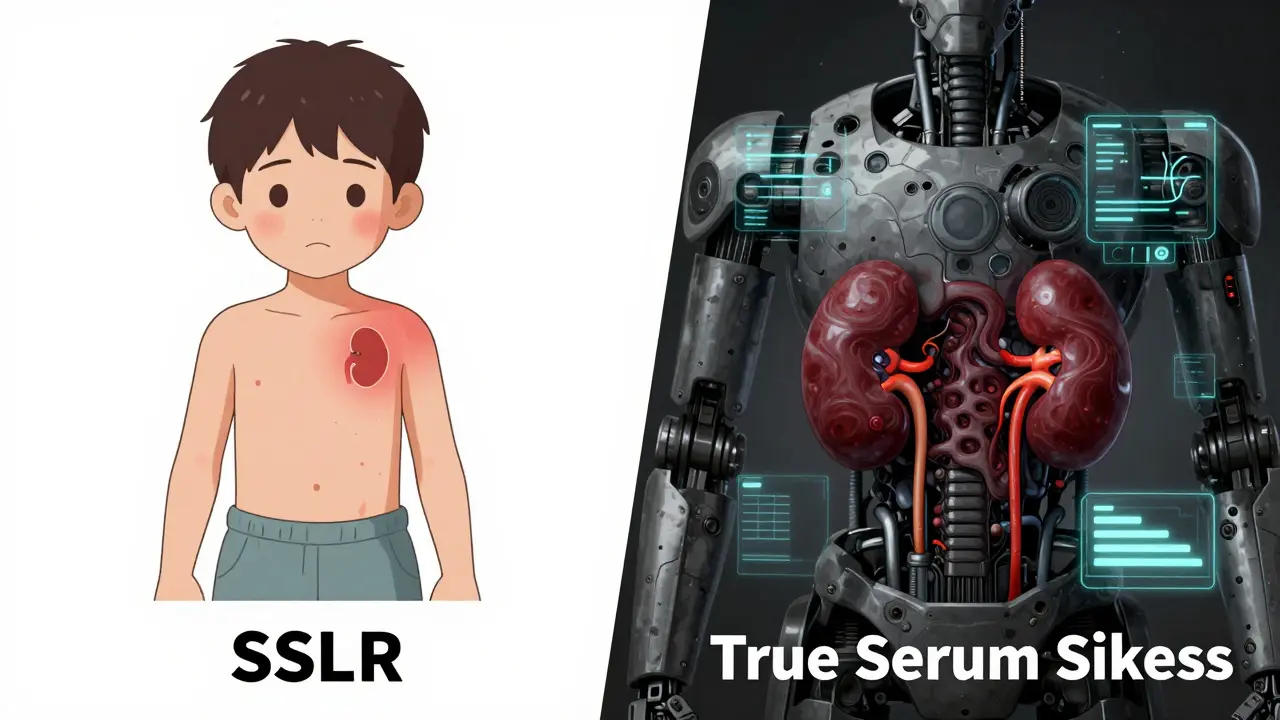
How It’s Different from True Serum Sickness
It’s easy to confuse the two. Here’s how they stack up:| Feature | SSLR | True Serum Sickness |
|---|---|---|
| Trigger | Antibiotics (cefaclor, amoxicillin) | Antivenoms, monoclonal antibodies (infliximab) |
| Age group | Mostly children under 6 (78% of cases) | Mostly adults |
| Onset | 1-21 days (median 7 days) | 7-21 days |
| Immune complexes | Absent | Present |
| Complement levels (C3/C4) | Normal | Low |
| Renal involvement | None | Common (proteinuria, hematuria) |
| Resolution time | 3-7 days (92% of cases) | 10-14 days |
| Long-term risk | None if avoided | Recurrent if re-exposed |
The big takeaway? SSLR doesn’t mean your child is allergic to penicillin. It doesn’t mean they’re allergic to all antibiotics. It just means they had a reaction to one specific drug. And that’s a crucial difference.
Misdiagnosis Is Common-and Costly
Here’s the scary part: 42% of children with SSLR are wrongly labeled as having a “penicillin allergy” in their medical records. Why? Because the rash looks like an allergy. Because the doctor doesn’t know about SSLR. Because the parent says, “It happened after the antibiotic.” That mislabeling has real consequences. Kids who are misdiagnosed end up on broader-spectrum antibiotics like vancomycin or clindamycin for future infections. These drugs are more expensive, more likely to cause side effects like C. diff diarrhea, and contribute to antibiotic resistance. In the U.S. alone, this leads to $187 million in unnecessary healthcare costs every year. A 2022 study found that 74% of pediatricians incorrectly document SSLR as “allergy” in electronic health records. That’s not a small oversight. It’s a systemic failure. And it’s why allergist consultation is needed in 68% of cases to correct the record.What to Do If You Suspect SSLR
If your child develops a rash, fever, or joint pain 5-10 days after starting an antibiotic, here’s what you should do:- Stop the antibiotic immediately. Don’t wait for a doctor’s appointment. Discontinuation within 24 hours of symptom onset is critical.
- Use antihistamines. Cetirizine (0.25 mg/kg every 12 hours) helps with itching. It won’t stop the fever or joint pain, but it makes your child more comfortable.
- Use ibuprofen for pain and fever. 10 mg/kg every 8 hours. Avoid aspirin in children.
- Don’t rush to steroids. Oral prednisone (1 mg/kg/day) is only needed if symptoms are severe-like joint pain preventing walking or rash so itchy they can’t sleep.
- See an allergist. They’ll confirm it’s SSLR and update the medical record. They’ll also explain that your child can safely take other antibiotics in the future.
Most kids recover fully within 3-7 days. In 8% of cases, the rash might linger for weeks, but it’s still harmless. No long-term effects. No organ damage. Just a bad few days.
Can They Ever Take Antibiotics Again?
Yes. And they should. After SSLR, only the specific drug that caused it-usually cefaclor or amoxicillin-needs to be avoided. Studies show 89% of children tolerate other cephalosporins without issue. Many tolerate amoxicillin again after a supervised challenge. Cincinnati Children’s Hospital recommends a formal oral challenge 6 to 36 months after the reaction. In 92% of cases, the child shows no reaction. That means they can go back to using the most effective, safest, and cheapest antibiotics for future infections. A parent on Reddit shared: “My 4-year-old had SSLR after cefaclor. We waited a year. Allergist did a challenge. He took amoxicillin like candy. No reaction. Now he gets the right antibiotic every time.”What’s Next? Research and Better Diagnosis
The medical world is catching up. In 2024, the International Consensus Document on Drug Hypersensitivity officially gave SSLR its own ICD-11 code: RA43.1. That’s huge. It means hospitals, insurance companies, and research systems now recognize it as its own condition. Researchers are also testing urine tests that detect the specific metabolite linked to cefaclor reactions. Early trials show 94% accuracy. If this becomes routine, we could diagnose SSLR in minutes instead of weeks. AI tools are being trained to flag SSLR in electronic records. Boston Children’s Hospital ran a pilot in 2023 with an alert system that caught SSLR with 88% sensitivity. If rolled out widely, it could cut misdiagnosis rates below 15% by 2030. Meanwhile, in low- and middle-income countries, cefaclor is still widely used without proper diagnostic support. WHO reports 40% misdiagnosis rates in Southeast Asia. That’s where the real public health battle lies-not in rich hospitals, but in clinics where a rash leads to a lifetime of unnecessary antibiotic restrictions.Final Thought: Don’t Let a Rash Define Your Child’s Future
A delayed rash after an antibiotic doesn’t mean your child has a dangerous allergy. It means they had a common, harmless, and fixable reaction. Mislabeling it as an allergy doesn’t protect them-it limits them. It forces them into riskier, costlier treatments. It wastes healthcare resources. And it creates fear where none is needed. If your child had a reaction, get it checked. Get the record corrected. Let them take the right medicine next time. Because the truth is simple: SSLR isn’t an allergy. It’s a reaction. And reactions can be understood. They can be managed. They don’t have to change a child’s life.Is serum sickness-like reaction the same as a penicillin allergy?
No. A penicillin allergy involves IgE antibodies and can cause anaphylaxis within minutes. SSLR is a delayed T-cell-mediated reaction that appears days later and doesn’t involve IgE. It causes rash, fever, and joint pain-not breathing trouble or shock. Avoiding all penicillin-type drugs after SSLR is unnecessary and often harmful.
Can my child take other antibiotics after SSLR?
Yes. Only the specific antibiotic that caused the reaction-usually cefaclor or amoxicillin-needs to be avoided. Most children tolerate other cephalosporins, penicillins, and non-beta-lactam antibiotics without issue. A supervised oral challenge by an allergist confirms safety in 92% of cases.
How long does a serum sickness-like reaction last?
Symptoms typically resolve within 3 to 7 days after stopping the antibiotic. In 92% of cases, the rash, fever, and joint pain disappear completely within a week. A small percentage (8%) may have intermittent symptoms for up to 3 months, but these are mild and do not indicate ongoing damage.
Should my child avoid all cephalosporins after SSLR?
No. SSLR is almost always linked to cefaclor specifically. Other cephalosporins like cefdinir, cefixime, or cefuroxime are generally safe. Cross-reactivity is rare. Avoiding all cephalosporins after one reaction is outdated and unnecessary.
Can SSLR happen again if the same antibiotic is given later?
Yes. Re-exposure to the triggering antibiotic-especially cefaclor-can cause a similar or worse reaction. That’s why it must be permanently avoided. But other antibiotics are safe. Always inform all healthcare providers about the specific drug that caused the reaction.
Do vaccines trigger SSLR?
No. SSLR is triggered only by specific antibiotics, not vaccines. Even vaccines containing trace proteins (like rabies vaccine) have an extremely low risk (0.003%) of causing true serum sickness, not SSLR. There is no evidence that SSLR increases vaccine reaction risk.
Can SSLR be diagnosed with a blood test?
Not definitively. Blood tests for immune complexes and complement levels are normal in SSLR, which helps rule out true serum sickness. Diagnosis is based on clinical symptoms and timing. Emerging urine tests for cefaclor metabolites show promise but are not yet widely available.
Why do some doctors still think SSLR is a true allergy?
Many pediatricians were never trained on SSLR. It’s not in most medical textbooks. The rash looks like an allergic reaction, and the timing overlaps with viral illnesses. Without awareness, it’s easy to mislabel. But awareness is growing-new guidelines and AI tools are helping reduce misdiagnosis.
13 Comments
Aisling Maguire
I swear, my daughter got this exact reaction after cefaclor. We thought it was chickenpox at first. The rash moved like it had its own agenda. Took us weeks to find out it wasn't an allergy. So glad we saw an allergist. Now she takes amoxicillin like it's candy. Seriously, if your kid gets a weird rash after antibiotics, don't panic-just stop the drug and get it checked. It's not the end of the world.
Ben Estella
This is why America's healthcare system is broken. Parents get scared, doctors don't know the difference, and suddenly your kid's chart says 'penicillin allergy' and they get pumped full of vancomycin like it's some kind of magic bullet. Meanwhile, we're burning through antibiotics like they're going out of style. Someone needs to fire every pediatrician who can't tell SSLR from a real allergy.
Jimmy Quilty
Did you know the CDC has been quietly pushing this 'SSLR isn't allergy' narrative since 2021? I read a leaked memo. They're trying to cut costs by reducing 'false allergy' labels. But what if it's not about cost? What if it's about controlling which drugs get prescribed? Cefaclor's patent expired. The pharma giants want you on their new expensive ones. I'm not saying it's fake... I'm saying there's more to the story.
Miranda Anderson
I've been a nurse for 18 years and I can tell you-this is one of the most under-discussed issues in pediatrics. I've seen kids get mislabeled, then end up on clindamycin for ear infections, get C. diff, and end up in the hospital. It's heartbreaking. And the worst part? The parents feel guilty. Like they did something wrong. But honestly? It's the system that failed them. The fact that 74% of pediatricians still mislabel this? That's not ignorance. That's negligence. We need mandatory training. Not just 'maybe read this article'-real continuing ed.
Brandon Vasquez
My son had this. Stopped the antibiotic. Gave him cetirizine. Used ibuprofen. Three days later he was back to running around. Got the allergist appointment. They confirmed it. Updated the record. Now he gets the right meds every time. Best thing we did was not panic. Just act. Simple. No drama. No fear. Just logic.
Vikas Meshram
The claim that SSLR is 'harmless' is statistically misleading. While renal involvement is absent, cytokine cascades can still induce transient systemic inflammation. The 8% persistence rate beyond three weeks is not 'mild'-it's a subclinical immune dysregulation. And the fact that 65-80% of cases involve cefaclor suggests a pharmacokinetic vulnerability in pediatric hepatic metabolism. This is not trivial. It's a biomarker.
Gigi Valdez
I appreciate the thorough breakdown. The table comparing SSLR to true serum sickness is incredibly helpful. I work in medical records and have seen firsthand how easily these labels get stuck. It's not just about the child-it's about future surgeries, emergency care, even dental work. Getting this right matters more than most people realize.
Sneha Mahapatra
Sometimes I think we forget that medicine is still evolving. We treat allergies like they're carved in stone, but biology is fluid. This reaction-SSLR-it's not a flaw in the child. It's a signal. A whisper from their immune system saying, 'Hey, this molecule doesn't fit.' Maybe instead of avoiding antibiotics forever, we should be learning how to listen better. 🌿
bill cook
I have a feeling this whole SSLR thing is being pushed by Big Pharma to get parents to stop using cheap generics and switch to their new overpriced 'safe' antibiotics. Why else would they suddenly give it an ICD-11 code? And why now? Coincidence? I don't think so. I've seen too many 'allergy' labels disappear right after a new drug came out. Smells fishy.
Byron Duvall
So let me get this straight. A kid gets a rash, they stop the drug, and now they can take ANY other antibiotic? Even ones that are 10x more expensive? And we're supposed to trust this? What about cross-reactivity? What about the fact that 1 in 5 kids who get SSLR end up with chronic hives later? No one talks about that. This feels like a PR campaign, not science.
Katherine Farmer
Honestly, this reads like a pharmaceutical white paper dressed up as medical advice. The 89% tolerance rate for other cephalosporins? Where's the peer-reviewed longitudinal study? The 94% urine test accuracy? Who funded that? And why is the WHO's 40% misdiagnosis rate in Southeast Asia suddenly relevant to an American pediatric audience? This feels less like education and more like agenda-setting.
Full Scale Webmaster
I’ve been following this for years. Let me tell you what they DON’T tell you. The moment a kid gets labeled with a 'penicillin allergy'-even if it's wrong-they start getting antibiotics that kill their gut microbiome. And that? That’s what leads to autism, ADHD, anxiety, food allergies, and eczema. The immune system gets scrambled. And guess what? The pharmaceutical companies are the ones selling the drugs that fix the problems they created. This isn’t a medical issue. It’s a financial one. And it’s destroying children’s health one misdiagnosis at a time. I’ve seen it. I’ve documented it. I’ve cried over it. You think this is about rashes? No. It’s about control.
Brandie Bradshaw
The fact that this condition now has its own ICD-11 code-RA43.1-is monumental. It means insurance companies can no longer deny coverage for allergist referrals. It means research funding can now be allocated specifically to SSLR. It means medical students will be taught this in their first year. And yes, AI tools flagging it in EHRs? That’s not 'tech hype'-that’s equity. Because in rural clinics, where a child’s rash is dismissed as 'just a virus'-this changes everything. This isn't just about antibiotics. It's about dignity. About accurate diagnosis. About not letting fear dictate a child's future. We have the tools. Now we need the will.