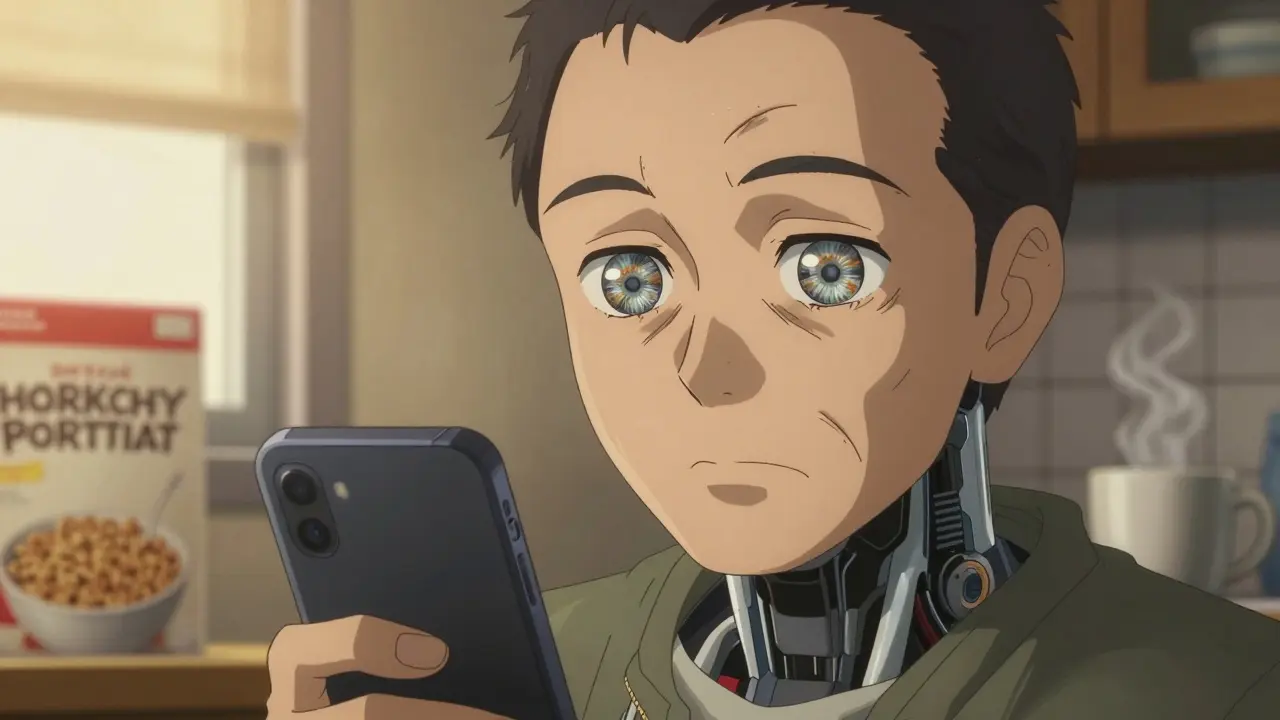
By your mid-40s, you might start holding your phone farther away to read a text. Or maybe your morning coffee routine now requires you to squint at the ingredient list on the cereal box. This isn’t just bad lighting or tired eyes-it’s presbyopia, a natural part of aging that affects nearly everyone. Unlike nearsightedness or farsightedness, presbyopia isn’t caused by the shape of your eyeball. It’s caused by your lens. As you age, the lens inside your eye slowly hardens and loses its flexibility. Think of it like an old rubber band that can’t stretch the way it used to. When you were younger, your lens could easily change shape to focus on things close up-like a book, a phone, or your watch. Now, it can’t bend enough. The result? Blurry close-up vision. It’s not a disease. It’s not your fault. It’s just biology.
Why Your Eyes Lose Near Focus
Your eye’s lens starts out soft and flexible in childhood. Every year, it adds another layer of cells-like rings in a tree trunk. By the time you hit 40, those layers have built up enough to make the lens stiff. Around age 45, most people notice they can’t focus on anything closer than about 16 inches. By 60, that distance can stretch to over 3 feet. That’s why you can’t read a menu without holding it out at arm’s length.
The technical term for this loss is reduced amplitude of accommodation. At age 10, your eyes can focus on something as close as 7 centimeters away. By age 60, that number jumps to over 100 centimeters. That’s not just inconvenient-it’s disruptive. Simple tasks like threading a needle, reading medicine labels, or scrolling through your tablet become harder. The National Eye Institute confirms this is universal: 100% of people develop presbyopia as they age. There’s no way around it. No eye exercises, no special diet, no supplements will stop it. Dr. Emily Chew from the NEI put it bluntly: “It’s as inevitable as gray hair.”
Reading Glasses: The Simple Fix
The most common solution? Reading glasses. They’re cheap, easy to find, and work immediately. You can buy them at any drugstore, supermarket, or online for under $20. They come in strengths from +0.75 to +3.50 diopters, increasing in 0.25 increments. Most people start with +1.00 or +1.25 around age 45. By 65, many need +2.50 to +3.00. But here’s the catch: over-the-counter readers aren’t customized. If one eye needs +1.50 and the other +1.75, you’re forcing both eyes to use the same strength. That can cause eye strain, headaches, or blurred vision.
A 2023 study from Optometry Times found that 35% of people who buy off-the-shelf readers pick the wrong strength. That’s not because they’re careless-it’s because they don’t know their exact number. A proper eye exam can measure your exact prescription. It’s not just about seeing better. It’s about avoiding fatigue. If you’re constantly squinting or leaning forward to read, your neck and eyes get tired faster. That’s why even simple tasks become draining.
Progressive Lenses: The Seamless Alternative
If you already wear glasses for distance vision, reading glasses aren’t practical. You’d have to keep switching between two pairs. That’s where progressive lenses come in. These are single lenses with three zones: top for distance, middle for intermediate (like computer screens), and bottom for reading. They look like regular glasses-no visible lines like bifocals. But they’re more complex. The transition between zones has to be precisely calculated based on your pupil distance, frame shape, and how you hold your head.
Adapting to progressives takes time. Most people need 2 to 4 weeks. Your brain has to learn to tilt your head slightly down to read, rather than just looking down. A 2023 Goodeyes.com survey found that 25% of first-time wearers experience peripheral distortion-things on the sides look blurry or wavy. That’s normal. It fades with use. But if you’re a graphic designer, mechanic, or driver who needs sharp vision in all directions, it can be frustrating. That’s why some companies now offer “trial kits” so you can test them before buying.
Other Options: Contacts, Surgery, and New Tech
Not everyone wants to wear glasses. Contact lenses can help too. Monovision contacts correct one eye for distance and the other for near vision. About 80% of people adapt to this setup, but 15% lose depth perception. That can make driving or playing sports harder. Some people try LASIK to create monovision surgically. It costs $2,000-$4,000 per eye, and while 85% of patients are satisfied, 10-15% need a second procedure within five years.
For those ready for a permanent fix, refractive lens exchange replaces your natural lens with a multifocal implant-similar to cataract surgery. It costs $3,500-$5,000 per eye. The upside? You won’t need glasses for reading or distance anymore. The downside? You might see halos around lights at night, and contrast sensitivity can drop. A 2021 JAMA Ophthalmology study found a 0.04% risk of serious infection, but outcomes are generally excellent for healthy candidates.
New innovations are coming fast. In March 2023, EssilorLuxottica launched Eyezen Progressive 2.0, which widens the reading zone by 30% based on data from 10,000 wearers. Johnson & Johnson’s Acuvue Oasys Multifocal contacts now use “Enhanced Near Technology” and showed 89% success in trials. Even more exciting? A topical eye drop called VP-025 is in early trials. It temporarily makes the pupil smaller, improving near vision for up to six hours. If approved, it could mean no glasses for some people-just a drop before reading.
What You Should Do Now
Start with a comprehensive eye exam at age 40. The American Academy of Ophthalmology recommends this for everyone, even if you think your vision is fine. Many age-related conditions-glaucoma, macular degeneration, diabetic retinopathy-show no symptoms until it’s too late. An exam includes cycloplegic refraction, which temporarily paralyzes the focusing muscle to get the true prescription. Without it, your add power might be underestimated by 0.25 to 0.50 diopters, leading to weak or uncomfortable lenses.
If you’re just starting to struggle with close-up tasks, try over-the-counter readers first. Pick the lowest strength that lets you read clearly. If they help, great. If they cause headaches or blur, see an optometrist. Don’t assume you need progressives right away. Many people use readers for reading, then switch back to distance glasses for driving. It’s not ideal, but it works.
If you’re already wearing distance glasses, ask about progressives. Try them with a trial frame before buying. Ask about corridor length-longer corridors (14-16mm) are better for computer users. Shorter ones (10-12mm) suit people who move their head more.
What Doesn’t Work
There’s a lot of misinformation out there. Eye exercises? They don’t change lens stiffness. Herbal supplements? No clinical evidence. “Vision training” apps? They might help with eye coordination, but not with presbyopia. The lens hardens because of age-not because you’re not “exercising” it enough. No amount of willpower or nutrition reverses this. Accepting that is the first step to finding the right solution.
Market and Cost: What’s Available
The global market for presbyopia correction hit $14.2 billion in 2022 and is expected to grow to over $25 billion by 2030. Reading glasses make up 65% of sales by volume but only 30% of revenue because they’re so cheap. Progressive lenses cost $250-$450. Bifocals are cheaper at $200-$350. Surgical options like lens replacement cost thousands, but they’re growing in popularity as safety improves. Online retailers like Zenni Optical and Warby Parker have made high-quality lenses more accessible. Zenni’s progressive lenses average $120, with free returns if you can’t adapt.
What’s clear? You’re not alone. Over 1.8 billion people worldwide are dealing with this. By 2030, that number will hit 2.1 billion. That’s more than the entire population of the United States and Europe combined. Presbyopia isn’t a minor inconvenience. It’s a global health reality. And for most people, the solution is simple: the right pair of glasses.
At what age does presbyopia usually start?
Most people start noticing symptoms between ages 40 and 45. It’s rare to see it before 40, and by 50, nearly everyone needs some form of near-vision correction. The exact timing varies slightly based on genetics and lifestyle, but it’s universal-everyone develops it eventually.
Can you prevent presbyopia with eye exercises or diet?
No. Presbyopia is caused by the natural hardening of the eye’s lens over time. No amount of eye exercises, supplements, or dietary changes can stop or reverse this process. Claims that you can “train” your eyes to focus better are not supported by science. The National Eye Institute confirms this: it’s as inevitable as gray hair.
Are over-the-counter reading glasses safe to use?
Yes, for occasional use. But if you’re wearing them daily or already need distance glasses, they may not be accurate. Off-the-shelf readers give both eyes the same strength, even if one eye needs more correction. This can cause eye strain or headaches. A proper eye exam ensures you get the right power for each eye and checks for other conditions like glaucoma or cataracts.
How long does it take to adjust to progressive lenses?
Most people adapt in 2 to 4 weeks. During that time, you might feel dizzy, notice blurry sides, or have trouble judging stairs. Your brain learns to use head movement instead of eye movement to focus. If you still feel uncomfortable after a month, your lenses might be improperly fitted. Check the pupillary distance and frame angle-these matter more than most people realize.
Is surgery better than glasses for presbyopia?
It depends. Surgery like refractive lens exchange removes your natural lens and replaces it with a multifocal implant. It works well for people who want to be glasses-free, especially if they’re already developing cataracts. But it’s expensive ($3,500-$5,000 per eye), carries small risks like halos or infection, and isn’t reversible. For most people, glasses or contacts remain the safer, more flexible choice.
Do I need an eye exam if I only have trouble reading?
Yes. Presbyopia is normal, but blurry near vision can also signal other problems-like early cataracts, diabetic eye disease, or macular degeneration. A comprehensive exam includes more than just checking your reading strength. It looks at pressure, retinal health, and nerve function. The American Academy of Ophthalmology recommends a baseline eye exam at age 40, even if you think your vision is fine.
13 Comments
Ferdinand Aton
I swear I started needing readers at 38. My mom said I was just lazy. Turns out I wasn't the only one. My kid thought I was being dramatic until she saw her own phone text blur at 42. We both bought $8 readers from the gas station. Best $16 I ever spent. 😅
Amina Aminkhuslen
Let me guess - you're one of those people who thinks reading glasses are a gateway drug to bifocals and then cataract surgery? Please. This isn't aging, it's surrender. You're not 'adapting' - you're capitulating to a corporate lens monopoly. The real villain? Big Optics. They profit from your fear of holding a book close. 💅
amber carrillo
I just turned 47 and I didn't realize how much I was straining until I got my first pair. It's like someone turned on a light in a room I didn't know was dark. No drama. No shame. Just clearer words on the page. I'm grateful. Really.
Tim Hnatko
For anyone new to this - start with +1.00. Don't jump to +2.00 because you think 'more power = better'. You'll end up with headaches and a weird neck crick. I learned the hard way. Try them on at the store. Read a magazine. If your eyes feel like they're doing yoga, it's too strong.
Aaron Pace
I tried progressives and felt like I was in a funhouse 😵💫 But after 3 weeks? Life changed. Now I can read my phone, check the dashboard, and see the microwave all in one glance. No more switching glasses. Worth the weird phase. Also - Zenni rocks. Got mine for $99 with free shipping. 🤘
Roland Silber
A lot of people don't realize that your pupil distance matters more than the power. I had a pair of progressives that gave me vertigo. Turned out the optician measured my PD wrong by 3mm. Took me 6 weeks to notice. Get it measured twice. Ask for a printout. It's your right. And if they roll their eyes? Go somewhere else.
Patrick Jackson
This isn't just about vision. It's about time. The moment you start holding things farther away - you realize you're no longer the person who could read a novel in bed at 2 a.m. without a lamp. It's the first real whisper of mortality. Not scary. Just... quiet. And beautiful in its own way. 🌅
Adebayo Muhammad
You're all being manipulated. The 'universal inevitability' narrative? Manufactured. The lens doesn't harden - it's the ciliary muscle atrophy from decades of screen staring. They don't want you to know about the 30-minute daily eye yoga protocol. Or the ancestral diet of wild greens and omega-3s from pre-industrial societies. This is a scam. The NEI is funded by lens manufacturers. I've seen the documents. 🔍
Pranay Roy
I've been using +1.25 readers since 43. But here's what they don't tell you - if you're on a high-sugar diet, it accelerates the lens stiffening. I read a paper once - it said glucose molecules bind to collagen in the lens. That's why Asians and Africans have slower onset. Low glycemic = delayed presbyopia. I'm not saying avoid sugar. I'm saying - your donut is stealing your vision. 🍩👁️
Joe Prism
I'm from Nigeria. We don't have reading glasses. We squint. We hold phones at arm's length. We use natural light. We adapt. The West turns aging into a product. It's not progress. It's commerce. I'm 50. I read with a magnifying glass my grandfather gave me. It works. Simple.
Bridget Verwey
Oh honey. You think you're being clever by buying $5 readers? You're just training your brain to hate reading. And your neck? Poor thing. I used to wear mine like a badge of honor - 'look at me, I'm too cool for glasses'. Then I got progressives. Now I look like a librarian who won a Nobel. And I'm happier than ever. 🙌
Andrew Poulin
Stop overcomplicating it. If you need readers, get them. If you need progressives, get them. If you want surgery, get it. Stop listening to people who think eye exercises fix biology. You don't need a PhD to hold a book. You need a pair of lenses. And if you're 45 and still pretending you don't need them? You're just making life harder. Just do it.
Weston Potgieter
I tried the eye drop. VP-025. Lasted 4 hours. Worked like magic. Then I read the label - 'not for use in glaucoma patients'. Oh. So I'm supposed to risk my eye pressure just to read a text? I went back to the $12 readers. At least I know what I'm getting into. Also - who approved this? Who's getting rich off this? 🤔