
When someone with Parkinson’s disease starts seeing things that aren’t there-people in the room, shadows moving, or loved ones talking when no one is there-it’s terrifying. These hallucinations and delusions are part of Parkinson’s disease psychosis (PDP), affecting nearly one in four patients. But treating them is a tightrope walk. The very drugs meant to calm the mind can slam the brakes on movement, making walking, talking, and even swallowing harder. This isn’t a side effect-it’s a direct clash between how the brain works in Parkinson’s and how antipsychotics are designed to work.
The Dopamine Dilemma
Parkinson’s disease starts with the slow death of dopamine-producing neurons in a part of the brain called the substantia nigra. Dopamine is the chemical that helps control smooth, coordinated movement. When levels drop, the classic signs appear: slow movements (bradykinesia), stiffness, tremors at rest, and trouble with balance. By 2023, about 1 million Americans were living with this condition, and the numbers keep climbing as the population ages. Now, add psychosis. About 24% of Parkinson’s patients end up hospitalized because of hallucinations or delusions. That’s more than just a mental health issue-it’s a crisis in daily life. Families struggle. Caregivers burn out. Patients lose independence. The problem? Most antipsychotics block dopamine receptors, especially the D2 subtype. That’s how they reduce hallucinations in schizophrenia. But in Parkinson’s, dopamine is already dangerously low. Blocking what’s left makes motor symptoms worse. It’s like trying to fix a leaky faucet by turning off the water main.Not All Antipsychotics Are Created Equal
There’s a huge difference between older and newer antipsychotics. First-generation drugs-like haloperidol, fluphenazine, and chlorpromazine-are especially dangerous. Haloperidol, often called Haldol, blocks 90-100% of D2 receptors at standard doses. In Parkinson’s patients, even tiny amounts-0.25 mg daily-can trigger severe stiffness, freezing, or falls. Studies show 70-80% of patients on haloperidol develop worsened parkinsonism. The Parkinson’s Foundation says these drugs should never be used in Parkinson’s patients. Second-generation antipsychotics were supposed to be safer. But many still carry risks. Risperidone, for example, worsens motor symptoms in nearly all patients. One 2005 study found that while risperidone reduced hallucinations as well as clozapine, it made movement worse by over 7 points on the Unified Parkinson’s Disease Rating Scale (UPDRS-III). That’s a big jump-enough to turn someone who walks with a cane into someone who needs a wheelchair. Olanzapine? It helped psychosis in 75% of patients in one study-but also made motor symptoms worse in 75%. Only one out of twelve patients could stay on it. The trade-off isn’t worth it.The Only Two That Might Work
There are two antipsychotics with real evidence supporting their use in Parkinson’s: clozapine and quetiapine. They don’t block dopamine as strongly. Clozapine binds to only 40-60% of D2 receptors and has a strong effect on serotonin receptors, which helps balance the brain without crushing movement. Clozapine is FDA-approved for PDP since 2016. It’s effective. But it’s not simple. It carries a 0.8% risk of agranulocytosis-a dangerous drop in white blood cells. That means patients need weekly blood tests for the first six months. If the absolute neutrophil count falls below 1,500 cells/μL, the drug must stop. Still, for many, it’s the only option that doesn’t destroy mobility. Quetiapine (Seroquel) is used off-label. It’s easier to monitor-no blood tests required. But here’s the catch: some studies show it works no better than a placebo. A 2017 trial found no significant difference between quetiapine and dummy pills in reducing hallucinations. Yet many neurologists still prescribe it because it’s safer than risperidone or olanzapine. The truth? It helps some people, maybe because of sedation or mild serotonin effects. But don’t expect miracles.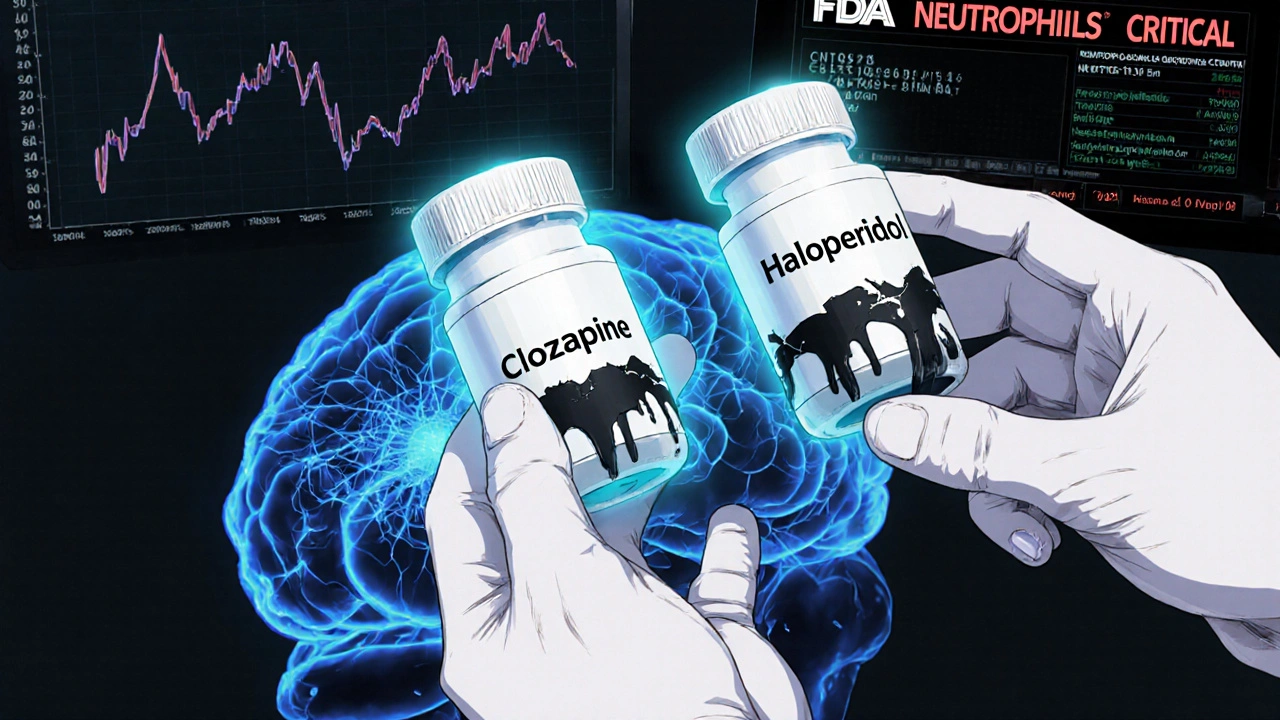
The New Hope: Pimavanserin and Lumateperone
In 2022, the FDA approved pimavanserin (Nuplazid), the first antipsychotic for Parkinson’s psychosis that doesn’t touch dopamine at all. It works by blocking serotonin 5-HT2A receptors-exactly the opposite of how older drugs work. In clinical trials, it improved hallucinations without making movement worse. The UPDRS-III scores barely budged. But there’s a dark side. Post-marketing data showed a 1.7-fold increase in death risk. The FDA added a black box warning. Still, for patients who can’t tolerate clozapine or have failed other options, it’s a tool. Even more promising is lumateperone. Early results from the HARMONY trial, expected in mid-2024, show a 3.4-point improvement in hallucinations with no motor decline. If confirmed, this could become the new standard. It’s selective, targeted, and avoids dopamine entirely.Before You Reach for an Antipsychotic
Most people don’t need antipsychotics at all. The Parkinson’s Foundation recommends a three-step approach before even thinking about medication:- Review all current drugs. Anticholinergics, amantadine, and dopamine agonists can trigger psychosis. Reducing or stopping them often clears up hallucinations.
- Adjust levodopa. Too much can cause hallucinations. Lowering the dose-even by 10-20%-can help without worsening movement.
- Improve sleep and lighting. Poor sleep and dim lighting worsen hallucinations. Simple changes-like nightlights and a regular bedtime-can make a big difference.
When You Must Use an Antipsychotic
If all else fails, start with clozapine. Begin at 6.25 mg at bedtime. Increase slowly-by 6.25 mg every week-until you hit 25-50 mg daily. Monitor UPDRS-III scores every two weeks. If motor symptoms worsen by more than 30%, stop. Blood counts must be checked weekly for the first six months. If clozapine isn’t an option, try quetiapine at 12.5-25 mg nightly. Increase to 50-100 mg if needed. Watch for sedation and dizziness. Don’t expect strong psychosis control-but you might avoid a motor crash.The Bottom Line
Treating psychosis in Parkinson’s isn’t about finding the strongest drug. It’s about finding the safest one. The goal isn’t to eliminate every hallucination-it’s to keep the person moving, safe, and connected to their family. Haloperidol and risperidone are not options. Olanzapine is risky. Clozapine works but demands vigilance. Quetiapine is a gamble. Pimavanserin has a black box warning. Lumateperone might be the future. The real win? Avoiding antipsychotics altogether by adjusting Parkinson’s meds, improving sleep, and optimizing the environment. That’s where most success stories begin.Can antipsychotics make Parkinson’s motor symptoms worse?
Yes, many antipsychotics can severely worsen motor symptoms because they block dopamine receptors-exactly the same receptors that are already low in Parkinson’s disease. First-generation drugs like haloperidol and risperidone are especially dangerous, often causing stiffness, freezing, and falls. Even low doses can trigger major declines in movement.
What antipsychotics are safe for Parkinson’s patients?
Only two have strong evidence for safety: clozapine and quetiapine. Clozapine is FDA-approved for Parkinson’s psychosis and doesn’t worsen movement at proper doses, but requires weekly blood tests due to the risk of agranulocytosis. Quetiapine is used off-label, has no blood monitoring requirement, but may work no better than a placebo in some patients. Both are far safer than older drugs like haloperidol or risperidone.
Is pimavanserin (Nuplazid) safe for Parkinson’s patients?
Pimavanserin doesn’t block dopamine, so it doesn’t worsen motor symptoms in clinical trials. However, post-marketing data showed a 1.7-fold increase in death risk, leading to a black box warning from the FDA. It’s an option for patients who can’t tolerate clozapine, but only after careful risk-benefit discussion with a specialist.
Can you treat Parkinson’s psychosis without antipsychotics?
Yes-often. In fact, about 62% of patients improve just by adjusting their Parkinson’s medications. Reducing anticholinergics, lowering levodopa, improving sleep, and adding nightlights can eliminate hallucinations without any antipsychotic. Always try this first before adding a new drug.
Why is haloperidol so dangerous for Parkinson’s patients?
Haloperidol blocks 90-100% of dopamine D2 receptors at standard doses. In Parkinson’s, dopamine is already critically low. Blocking what’s left causes severe parkinsonism-rigidity, tremors, freezing, and difficulty swallowing. Even 0.25 mg daily can trigger a crisis. The Parkinson’s Foundation advises against its use entirely in this population.
What should caregivers watch for when a Parkinson’s patient starts an antipsychotic?
Watch for sudden stiffness, slower walking, increased freezing episodes, or trouble speaking or swallowing. These are signs the drug is worsening motor symptoms. If UPDRS-III scores rise by more than 30% from baseline, contact the doctor immediately. For clozapine, also watch for fever, sore throat, or fatigue-signs of low white blood cells. Weekly blood tests are mandatory.
13 Comments
Chrisna Bronkhorst
Let’s be real - most docs just reach for Haldol because it’s cheap and fast. No one wants to deal with weekly blood draws or the hassle of clozapine. But then the patient freezes mid-step and falls. Family panics. ER visit. All because someone didn’t read the damn guidelines.
Stop treating psychosis like it’s schizophrenia. Parkinson’s isn’t a mental illness - it’s a movement disorder with psychiatric side effects. Fix the meds first. Sleep. Lighting. Reduce anticholinergics. Done. 62% improve without antipsychotics. That’s not a fluke. That’s the playbook.
Amie Wilde
Quetiapine is a placebo with side effects.
Gary Hattis
As someone who’s watched my dad go from walking the dog daily to needing a wheelchair after a neurologist prescribed risperidone - I’m livid.
They didn’t even ask if he was on anticholinergics. Didn’t check his levodopa dose. Just said, ‘Here, this’ll calm the visions.’
Three weeks later, he couldn’t swallow his own saliva. We had to tube-feed him for months. The hallucinations? Still there. But now he’s got a new set of problems.
Pimavanserin saved his life. Not because it’s magic - but because it didn’t kill his mobility. The black box warning? Yeah, scary. But so is watching your dad turn into a statue.
Doctors need to stop treating Parkinson’s psychosis like a psychiatric afterthought. It’s a neurological emergency wrapped in a psychiatric symptom. And we’re still treating it like it’s 1998.
Esperanza Decor
I’m a caregiver for my mom who’s had PD for 12 years. We tried everything before meds - nightlights, cutting out Benadryl, adjusting her Sinemet timing. It worked for a while. Then the voices came back - louder, meaner. Told her the neighbors were stealing her pills.
We went with quetiapine. Didn’t help much. But she didn’t freeze. She slept. And that was enough.
Now we’re waiting for lumateperone trials. If it’s real, it could change everything. I’ve read the HARMONY data. It’s promising. Not perfect. But better than losing her to a drug that was supposed to help.
Also - if your neurologist says ‘just reduce the dopamine’ - ask them how much they’ve actually seen in real patients. Most haven’t. They read studies. We live them.
Deepa Lakshminarasimhan
They don’t want you to know this but clozapine and pimavanserin are controlled by Big Pharma to keep people dependent. The real cure is magnesium, B12, and grounding. The FDA black box? A distraction. They don’t want you to know that dopamine isn’t the problem - it’s glyphosate in your food and 5G messing with your brainwaves.
My cousin stopped all meds, drank apple cider vinegar, and now she dances every morning. No hallucinations. No rigidity. Just pure energy.
Why do you think they push these expensive drugs? Because they’re profitable. Not because they work.
Erica Cruz
Ugh. Another ‘Parkinson’s is special’ post. Newsflash: all psychosis is dopamine-driven. If you can’t tolerate dopamine blockade, then tough. Maybe don’t have PD then.
Quetiapine doesn’t work? Good. Then stop whining and get on clozapine. Or pimavanserin. Or whatever the new $12,000/month magic bullet is.
Meanwhile, I’m over here watching my neighbor’s mom on haloperidol - she’s lucid, calm, and can still feed herself. Her UPDRS score is trash? So what? At least she’s not screaming at imaginary people.
Move on. This isn’t a TED Talk. It’s medicine.
Johnson Abraham
lol so clozapine needs blood tests? that’s a pain in the ass. why not just give them a lil haldol and call it a day? they’re gonna die anyway right? 🤷♂️
also why are we even talking about this? just give them weed. i heard it helps with both the shakes and the voices. plus no blood work. win win.
also pimavanserin sounds like a brand of energy drink. who names this stuff??
Shante Ajadeen
Thank you for writing this. I’ve been trying to explain this to my sister for months. She’s a nurse and thinks ‘antipsychotic = antipsychotic.’
I showed her the part about reducing levodopa first - she didn’t even know that was an option.
My dad was on risperidone for 6 weeks. We thought it was helping until he couldn’t get out of his chair. We switched to quetiapine. He still sees things - but now he can walk to the bathroom again.
It’s not about eliminating every hallucination. It’s about keeping him human. And that’s worth more than any drug label.
dace yates
Does anyone have data on how many patients on clozapine develop agranulocytosis after the first six months? The studies say it’s rare after that, but I’ve heard anecdotal cases of it happening at 18 months. Is that just outlier stories or is there something we’re missing?
Danae Miley
Correction: The 2017 quetiapine trial didn’t find it ‘no better than placebo’ - it found no statistically significant difference in primary endpoints, but secondary outcomes (caregiver burden, sleep quality) showed modest improvement. Also, the sample size was underpowered. Don’t dismiss it outright. Context matters.
Charles Lewis
It is imperative to underscore that the pharmacological management of Parkinson’s disease psychosis represents one of the most complex and nuanced challenges in contemporary neurology. The fundamental pathophysiological conflict between dopaminergic replacement therapy and dopamine receptor antagonism necessitates a highly individualized, multidisciplinary approach. Clinicians must not only be conversant with the pharmacokinetic and pharmacodynamic profiles of each antipsychotic agent but also possess a deep understanding of the progressive neurodegenerative trajectory of Parkinson’s disease itself. The ethical imperative to preserve both cognitive clarity and motor autonomy demands that we eschew simplistic, one-size-fits-all protocols in favor of nuanced, patient-centered decision-making frameworks that prioritize quality of life over mere symptom suppression. The emergence of non-dopaminergic agents such as pimavanserin and lumateperone represents not merely a therapeutic advance, but a paradigm shift in our conceptualization of psychosis in neurodegenerative disease.
Renee Ruth
They’re lying about the black box warning. Pimavanserin doesn’t kill people - the blood tests for clozapine do. People die waiting for results. They die because they can’t afford the $1200/month. They die because their insurance won’t cover the monitoring.
This isn’t science. It’s capitalism dressed up in white coats.
Samantha Wade
This is one of the most thorough, compassionate, and clinically accurate summaries I’ve read on this topic. Thank you for highlighting the human cost behind the UPDRS scores. Too often, we reduce patients to numbers - tremor rating, freezing episodes, hallucination frequency. But behind every score is someone who used to dance with their grandkids, who still wants to taste their coffee, who still wants to hear their spouse’s voice without fear.
Let’s not forget: the goal isn’t to eliminate every shadow. It’s to let them sit on the porch again. And that’s worth every blood draw, every sleepless night, every careful dose adjustment.
Sharing this with my entire neurology team tomorrow. This is what education looks like.