
Have you ever wondered why a generic pill costs a fraction of the brand-name version but works exactly the same way in your body? The answer isn't magic; it's rigorous science. At the heart of this trust is dissolution testing, a critical quality control process mandated by the U.S. Food and Drug Administration (FDA) to guarantee that generic drugs perform identically to their reference listed drugs (RLDs). Without this step, we couldn't be sure that the medication you buy at the pharmacy will dissolve and absorb into your bloodstream at the right speed.
Dissolution testing acts as an in vitro predictor of how a drug behaves inside the human body. It ensures therapeutic equivalence, meaning the generic provides the same clinical effect and safety profile as the original brand-name product. This article breaks down how the FDA uses these tests to approve generics, what specific data manufacturers must submit, and why this process matters for patient safety.
The Core Purpose of Dissolution Testing
When you swallow a tablet, it doesn't just vanish. It must break apart, or dissolve, so your body can absorb the active pharmaceutical ingredient (API). If a drug dissolves too slowly, you might not get enough medicine into your system. If it dissolves too quickly, you could risk side effects from a sudden spike in concentration. The FDA requires dissolution testing to verify that generic products release their ingredients at rates comparable to the reference product.
This testing serves as a surrogate for in vivo performance assessment. In simpler terms, instead of constantly running expensive and time-consuming human clinical trials for every new generic batch, regulators rely on these lab-based tests to predict bioavailability. For oral solid doses, oral semi-solids, and oral suspensions, this is mandatory. However, drugs already in solution, like oral liquids or topical creams, are exempt because they don't need to dissolve further in the stomach.
The primary goal is twofold: ensure equivalent therapeutic performance and reduce unnecessary human bioequivalence studies. By proving that a generic dissolves similarly to the brand name, manufacturers can often skip certain clinical phases, speeding up access to affordable medicines without compromising quality.
FDA Requirements for ANDA Submissions
To get a generic drug approved, companies must file an Abbreviated New Drug Application (ANDA). Unlike New Drug Applications (NDAs) for brand-name drugs, which require extensive animal and clinical studies, ANDAs waive those requirements based on the premise that the generic is bioequivalent to an already-approved drug. However, the burden shifts to chemistry, manufacturing, and controls (CMC) data, specifically dissolution profiles.
According to FDA guidance updated in September 2023, applicants must provide comprehensive dissolution data across five specific categories:
- Solubility Characteristics: Data showing how the bulk drug substance dissolves under various conditions.
- Method Validation: Proof that the chosen test conditions-such as instrument type, rotation speed, and medium composition-are valid and consistent.
- Robustness Verification: Tests demonstrating that small changes in parameters won't drastically alter results.
- Analytical Validity: Confirmation that the method used to measure dissolved drug is accurate and precise.
- Discriminatory Ability: Evidence that the method can distinguish between good and bad batches, crucial for sustained-release products.
For immediate-release oral solids, the standard rule of thumb is that at least 80% of the drug must release within 45 minutes. But this isn't a one-size-fits-all metric. The exact timeframe depends on the specific drug's properties. Manufacturers must detail everything from the USP Apparatus type (usually 1 or 2) to the pH of the buffer solutions used.

Standardized Methods and the BCS Biowaiver
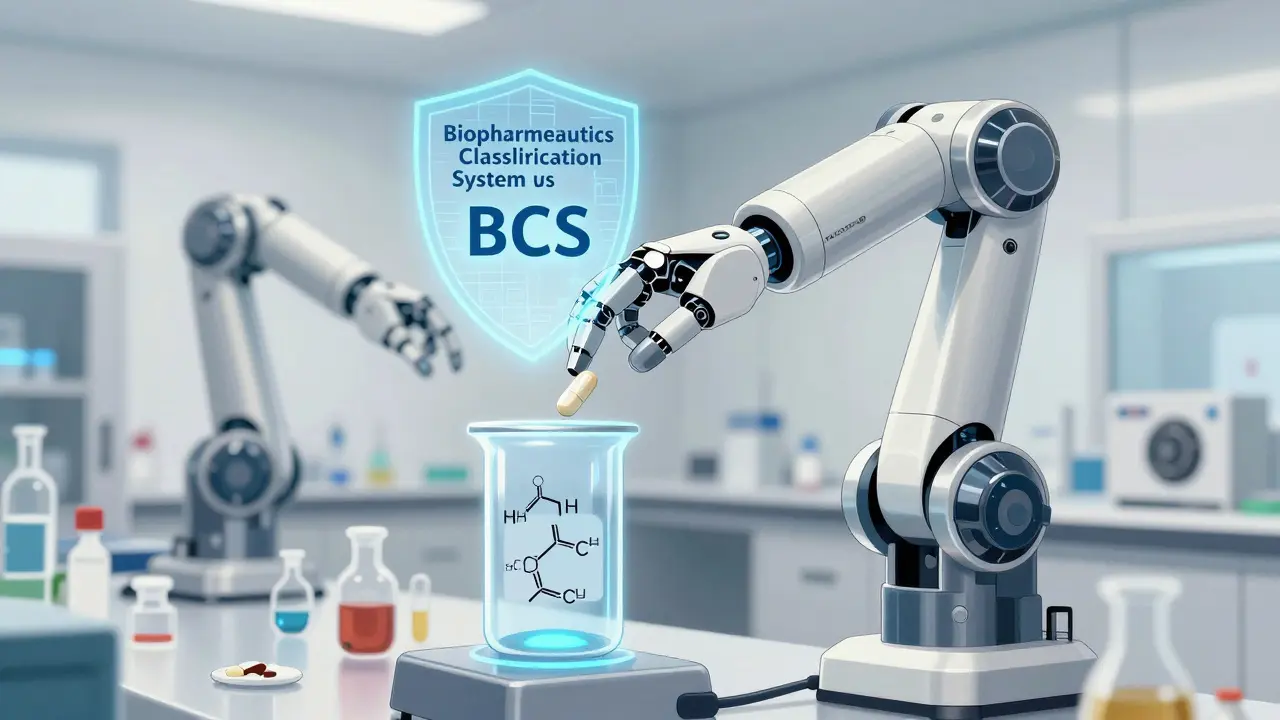
Not all drugs are created equal. Some dissolve easily in water, while others struggle. To handle this complexity, the FDA uses the Biopharmaceutics Classification System (BCS). This system categorizes drugs based on solubility and permeability. For BCS Class I drugs-which have high solubility and high permeability-the FDA introduced a streamlined approach in its August 2018 guidance.
These highly soluble drugs qualify for a "biowaiver." This means if the generic manufacturer can prove through dissolution testing that their product dissolves similarly to the reference drug, they don't need to conduct human bioequivalence studies at all. The FDA specifies a single-point test at 30 minutes using 900 mL of 0.1N HCl for these cases. This significantly cuts development time and cost.
| Drug Category | Key Requirement | Bioequivalence Study Needed? |
|---|---|---|
| BCS Class I (High Sol/Perm) | Single-point test at 30 mins in 0.1N HCl | No (Biowaiver eligible) |
| Immediate-Release Solid Dose | ≥80% release in 45 mins (typical) | Yes, unless biowaiver applies |
| Modified-Release/Sustained-Release | Multi-pH testing + Alcohol challenge | Yes, plus complex dissolution profiling |
However, for modified-release products, the stakes are higher. These drugs are designed to release medication slowly over hours or days. The FDA requires evaluation under multiple pH conditions (typically 1.2, 4.5, and 6.8) to simulate different parts of the gastrointestinal tract. They also mandate alcohol challenge testing to ensure the drug doesn't "dump" its entire dose if taken with beer or wine, which could lead to dangerous toxicity.
Measuring Similarity: The f2 Factor
How does the FDA decide if two dissolution curves are similar enough? They use a mathematical calculation called the f2 similarity factor. This statistic compares the dissolution profiles of the test product (generic) and the reference product (brand name) over time.
The f2 value ranges from 0 to 100. A score of 50 or greater indicates statistical equivalence. If the f2 value drops below 50, the FDA considers the profiles distinct, raising red flags about potential differences in how the drugs behave in the body. This metric is central to the approval process for immediate-release products where biowaivers aren't granted.
It's important to note that the FDA views dissolution testing as a diagnostic tool. If comparative data shows substantial differences but in vivo data looks acceptable, the agency may establish unique dissolution specifications for that specific generic product. This flexibility ensures that safe and effective generics reach the market even if their physical properties differ slightly from the brand name, as long as the therapeutic outcome is identical.
Real-World Challenges for Manufacturers
Developing these methods isn't just paperwork. Industry professionals report that creating appropriate dissolution methods for complex products can take 6 to 12 months. One major hurdle is simulating actual gastrointestinal conditions accurately. The FDA maintains a Dissolution Methods Database with recommendations for over 2,800 drug products, serving as a vital resource for developers.
Manufacturers must also navigate the SUPAC-IR (Scale-Up and Post-Approval Changes) framework. If a company changes its manufacturing site, API source, or excipient levels after approval, they must prove via dissolution testing that these changes haven't altered the drug's performance. This requires comparative testing at multiple time points to ensure no negative impact on bioavailability.
The documentation burden is significant. Submissions typically include 50 to 100 pages of method development data per product in module 3.2.P.5 of the ANDA. Experts like Dr. Lawrence Yu, former Deputy Director of FDA's Office of Pharmaceutical Quality, have emphasized that this rigor allows the agency to reduce regulatory burdens on human studies without sacrificing product quality. As of late 2023, industry analysts predicted that roughly 35% of generic approvals would leverage standardized dissolution methodologies to streamline development, up from 25% in 2020.
Future Directions in Regulatory Science
The field isn't standing still. The FDA continues to refine its guidelines, with recent updates emphasizing product-specific methods regardless of whether they come from the USP, FDA, or internal development. There is growing interest in physiologically relevant dissolution testing methods that better mimic the human gut environment. These advanced techniques could improve the predictability of in vitro results for in vivo performance, especially for difficult-to-formulate drugs.
Additionally, the FDA has signaled potential expansion of BCS-based approaches. Draft guidance issued in 2022 suggested extending biowaivers to BCS Class III drugs (high solubility, low permeability) under specific conditions. This shift reflects a broader trend toward using robust in vitro data to replace in vivo studies wherever scientifically justified, making generic drug development faster and more efficient.
What is dissolution testing in simple terms?
Dissolution testing is a lab procedure that measures how fast a drug dissolves in a liquid solution. It mimics how the drug would break down in the human stomach or intestines. The FDA uses this test to ensure generic drugs release their active ingredients at the same rate as brand-name drugs.
Why do some generic drugs not need human testing?
Drugs classified as BCS Class I (high solubility and high permeability) can qualify for a "biowaiver." If dissolution testing proves the generic dissolves identically to the brand name, the FDA assumes it will behave the same way in the body, eliminating the need for costly and time-consuming human bioequivalence studies.
What does an f2 value of 50 mean?
The f2 similarity factor compares the dissolution profiles of two drugs. A value of 50 or higher indicates that the profiles are statistically similar. If the value is below 50, the FDA considers the dissolution rates significantly different, which may require further investigation or additional clinical data.
Are all pills subject to dissolution testing?
No. The FDA mandates dissolution testing for oral solid doses, oral semi-solids, and oral suspensions. Drugs that are already in solution, such as oral liquids, syrups, or topical formulations, are generally exempt because they do not need to dissolve further to be absorbed.
How does the FDA handle changes in generic manufacturing?
Under the SUPAC-IR framework, if a manufacturer changes production sites, raw material sources, or processes, they must perform comparative dissolution testing. This ensures that the changes do not negatively affect how the drug dissolves and performs in the body, maintaining the established bioequivalence.
What is the difference between ANDA and NDA regarding dissolution?
An NDA (New Drug Application) for a brand-name drug requires extensive clinical and animal studies to prove safety and efficacy. An ANDA (Abbreviated New Drug Application) for a generic skips these clinical studies but requires rigorous dissolution testing and bioequivalence data to prove it matches the already-approved brand-name drug.
Why is alcohol challenge testing required for some generics?
Alcohol challenge testing is required for modified-release products to check for "dose-dumping." This ensures that if a patient takes the medication with alcohol, the drug doesn't release its entire contents all at once, which could cause toxic levels of the drug in the bloodstream.
9 Comments
Ramanath Rao
So you're telling me the FDA just trusts a beaker of liquid to tell them if a drug is safe? That sounds incredibly lazy. I mean, really? My grandmother took generics and ended up in the ER because the 'bioequivalence' was supposedly fine but her body reacted like it was poison. This whole system is rigged for pharma profits not patient safety. The f2 factor is a joke statistic designed to let bad batches through.
irine sabrina
Oh my goodness, Ramanath, please take a deep breath! 😊 It's actually quite fascinating how they use these tests to save lives AND money. Think about it-without dissolution testing, we'd need thousands more human trials which is ethically tricky and super expensive. The science behind BCS Class I biowaivers is genuinely beautiful because it trusts chemistry over guesswork. Isn't it wonderful that we can access affordable meds safely?
Gary Helminiak
I have to chime in here because as someone who works in QC lab validation, this article misses some nuance but gets the gist right 🧪✨ You know, the f2 similarity factor isn't just a random number game; it’s a rigorous statistical tool derived from reciprocal log transformations of difference factors. When we validate methods for sustained-release products, we don’t just look at one time point-we run multi-pH media tests to simulate the entire GI tract journey from stomach acid (pH 1.2) to intestinal buffers (pH 6.8). It’s actually pretty cool how SUPAC-IR guidelines allow manufacturers to tweak excipients without redoing full clinical trials, provided the dissolution profile stays within those tight confidence intervals. I’ve spent months optimizing rotation speeds on USP Apparatus 2 just to get that discriminatory ability right so we can catch batch-to-batch variations before they hit the market 📉📈
Christina Mitchell
It makes me think about the nature of trust in systems we cannot see. We swallow these pills believing in an invisible process governed by distant regulators. Is it faith or is it science? Perhaps both. The idea that a mathematical model like the f2 value can stand in for human experience is profound. It suggests that our bodies are predictable machines, which is comforting yet slightly dehumanizing. Still, knowing there is such rigorous oversight brings a sense of peace to the chaos of modern healthcare.
Joseph Teichman
good read tho i think ppl forget that generics r literally the same chemically just different binders mostly. saves cash for sure. dont overthink it guys.
Gareth Tyler
i find the alcohol challenge test interesting. most people dont realize drinking with their meds can break the release mechanism. its a small detail but shows how much thought goes into these protocols. keeps us safe even when we make mistakes
Sharon O’Mahonh
hey everyone lets keep the vibes positive here okay because honestly the regulatory framework is doing amazing work under pressure. the shift towards physiologically relevant dissolution testing is huge for inclusivity in pharma development since it better mimics diverse gut environments. we should celebrate the scientists working tirelessly on method validation and robustness verification instead of tearing down the system. remember that bioequivalence studies are waived for good reason based on solid data not laziness. lets support accessible healthcare together 💖
Jonhnnie john13
the author clearly has no understanding of real world manufacturing variances. dissolution specs are often too tight leading to unnecessary batch rejects while missing actual clinical failures. it is a bureaucratic exercise not a scientific guarantee. stop pretending this ensures quality it only ensures compliance with arbitrary numbers.
Madeline Petes
wow johnnie u sound bitter lol. maybe try reading the part about how f2 values below 50 trigger red flags? its not perfect but its way better than nothing. i appreciate the detailed breakdown of ANDA vs NDA requirements though. helps clarify why generics are cheaper. thanks for sharing this info!